

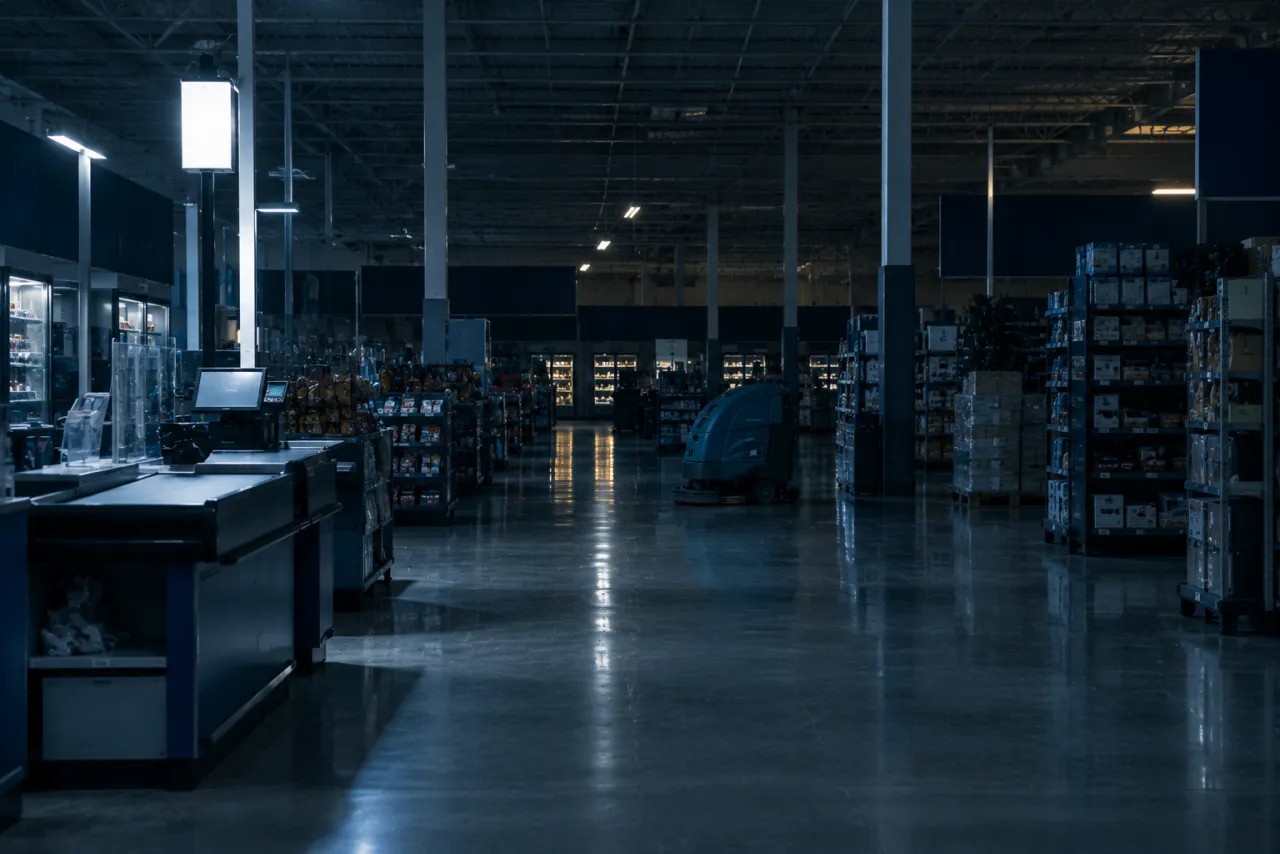
“Just leave it, nobody’s gonna notice till Monday.”
An associate said it to a coworker four steps past the entrance at 8:47 p.m., nodding at a promotional display that had slid sideways sometime that afternoon and was now sitting across the mouth of the aisle behind it. Neither of them noticed the auditor walking past with a phone raised at chest height, already three photos into the visit.
8:47 p.m.: Through the Door
The parking lot lighting was fine, all of it working, nothing to note there. Both cart corrals near the entrance stood empty, which meant every cart in the building was already in use somewhere inside, forty minutes before close on a Sunday. The display blocking the aisle behind the entrance was the kind of thing that reads as a minor housekeeping note during the day and a real hazard once a crowd needs to move past it fast.
Daytime audits do not usually catch a cart shortage like this, because daytime traffic returns carts to the corral in smaller, steadier waves throughout the day. Sunday evening runs differently: most of a week’s shopping happens inside the same two-hour window, and whatever a program decided about when stores get visited quietly decides which version of the store ever gets seen.
The restrooms, checked at 8:52 p.m., told a related story: paper stocked, floors clean, but the light in the second stall out since sometime that afternoon, according to the maintenance log taped inside the door. Nobody had called it in yet, which made sense. Whoever would normally notice a burned-out bulb during a slow afternoon was, at that hour, running the only open register.
The Floor After the Weekend
Aisle six had the same slumped shelf the associate near the entrance had already been talking about, snack bags folded over each other where a facer reset should have kept the front row upright. Three shelf tags in produce did not match the price posted at the scale two aisles over, a gap that had probably opened sometime Saturday and simply never closed. None of it looked deliberate. It looked like a store that had been busy since Friday morning and had not yet caught its breath.
A weekday morning audit usually walks into a store that opened a few hours earlier and has had a slow, quiet stretch to true itself up. A Sunday night audit walks into a store carrying three straight days of volume with the smallest crew of the week on the floor. The findings are not the same store’s problems twice. They are two different versions of the same store, and only one of them is usually the one that gets measured.
An endcap two aisles further in had fared worse: the header sign was correct, but half the product had been pulled by Saturday’s traffic and never rebuilt, leaving a promotion advertised over mostly empty pegs. A weekday morning audit two hours after opening would likely have caught the same endcap freshly built and called it a pass.
Self-Checkout Is the Store Now
By 9:20 p.m. the staffed lanes had narrowed to one, and the self-checkout bank was carrying the rest of the store’s Sunday-night volume with a single associate stationed to cover overrides, bag checks, and two customers who could not get a coupon to scan. For about six minutes she was also the only staff member visible anywhere on the sales floor. At 9:24 p.m. a different customer waved for help twice before the associate could break away from the register she was already covering, a wait of maybe ninety seconds that played out in view of six other people queued at the self-checkout bank.
The self-checkout problems that show up in a daytime audit tend to be about friction: a slow scanner, a confusing prompt. At night, with one person covering what would be three or four roles during the day, the problem changes shape. It becomes a coverage problem wearing a technology complaint’s clothes, and the two get confused for each other more often than a dashboard built for daytime numbers would suggest.
The Service Desk, Dark
The service desk closed at 9 p.m., a full hour before the store did. A returns sign taped to the counter pointed customers to customer service the next morning, for whatever came up in the meantime.
9:55 p.m.: Close
By closing, the count stood at eleven findings: a slumped shelf, three mismatched tags, two empty corrals, a blocked aisle behind the entrance display, an unstaffed hour at the service desk, and a self-checkout bank running most of the store’s back half on one associate. None of the eleven would have surprised anyone who worked that Sunday shift. They were not secrets. They had simply never been written down anywhere a district office would see them, because the store had never been visited at 9 p.m. on a Sunday before.
The report went through the same review any Signal Retail visit goes through before a client sees it: a second read against the photos and timestamps, confirming that eleven findings meant eleven findings and not nine with two counted twice.
The report that went out that week did not recommend a bigger staff or a longer service desk schedule, decisions that belong to the people who run the P&L, not the people who observe it. It recommended treating the visit as a first data point for a policy drift and metric pressure audit at the same hour, six weeks out, to see whether eleven findings on a first Sunday night were a pattern or a single bad week caught once.