

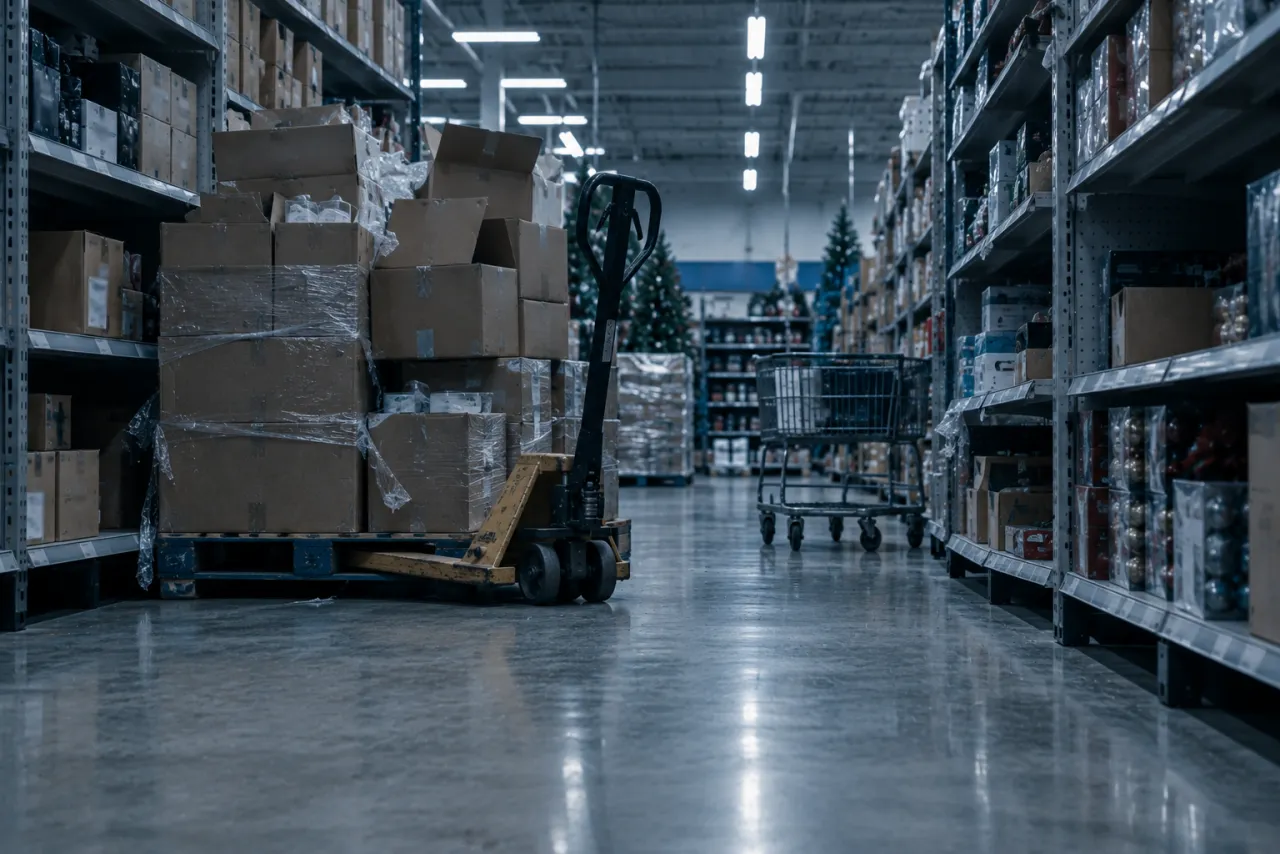
A pallet jack sits nose-out in aisle 9 at Store 12, forks still raised, while the stocker three feet away breaks down a pallet of holiday glassware. A shopper pushing a cart toward the registers stops, looks for a way around, and finds none. Behind her, a second cart backs up. Somewhere past the endcap, a case of string lights waits its turn on a hand truck.
The stocker finishes in six minutes and moves the jack to aisle 11, where the same thing starts again. Multiply that by every pallet coming off every truck this week, and the aisle is not blocked for a moment. It is blocked for a large, unscheduled share of the shift. A store running normal freight volume absorbs that kind of congestion in short bursts. A store absorbing double volume for six or eight weeks straight is carrying a permanent condition and rarely books it as one.
Freight teams size a surge in cases per truck and labor hours per truck. Store safety almost never gets its own line item, so the cost of a blocked aisle gets scattered across four other budgets instead of counted as its own. Four cost lines carry that weight during any stretch when freight volume climbs faster than floor labor does, and each one is worth pricing out before the trucks start arriving twice a week instead of once.
The Slip-and-Fall Claim
A pallet jack fork left in a traffic lane, a stray corner of shrink wrap, a case that split and spilled six bottles of dish soap: any one of these is what a claims adjuster calls a known condition. The exposure is not the freight itself. It is how long the hazard sat there before someone corrected it, and whether the store can prove it was checked.
Liability figures for a slip-and-fall claim vary enormously by state, by insurer, and by whether the store can produce evidence the aisle was walked that day. Signal Retail does not publish a number for what a claim costs, because there is no honest single number to publish. What a retail integrity audit can do is put a trained, anonymous set of eyes on the aisle during the exact hours freight is landing, and document the condition with a photo and a timestamp before it becomes someone’s insurance file.
The Trip That Turns Around
Picture a shopper who came in for six items and hits the blocked aisle at item three. She does not complain, and she does not find a manager. She sets down whatever is in the cart, or she never picks it up in the first place, and she leaves. That trip never generates a return, a complaint, or a line on a dashboard. From the store’s point of view, it simply did not happen.
The abandoned trip is the hardest cost line to price and the easiest one to dismiss for exactly that reason. What happens in the first minute of a visit decides more of the outcome than anything the store does afterward, and a blocked aisle is one of the fastest ways to end a trip before it starts.
ADA and Fire Code Exposure
Aisle width and clear-path requirements are not a suggestion. They are code, and code enforcement does not pause for a freight surge. A wheelchair user who cannot pass a staged pallet has a legitimate complaint. A fire marshal who walks a blocked cross-aisle during a routine inspection has a citation to write.
How that exposure translates into dollars depends on jurisdiction, on the specific code cited, and on whether the condition reads as a one-time lapse or a pattern across visits. A documented pattern is worse than a single bad afternoon, and it is the kind of pattern that shows up in a compliance record only if someone is checking on the days nobody expects to be checked.
Working the Same Freight Twice
Every case that gets set down in the aisle, stepped around, and picked up again later is a labor minute spent twice on the same box. A stocker who stages product in the traffic lane because the backroom is already full, or because the schedule has no room for a second pass, is not being careless. The stocker is responding to whatever the store is measuring that week, usually cases per hour or trucks unloaded per shift.
When the incentive is speed off the truck and clearing the aisle is nobody’s incentive at all, the aisle loses, and someone works the same freight twice to fix it later. That kind of gap between what gets measured and what actually needs protecting is exactly what a policy drift audit is built to surface. The stocker’s judgment is rarely the problem; the incentive underneath it is.
What the Ledger Leaves Out
None of these four lines shows up on the same report. The claim goes to legal, the abandoned trip goes nowhere, the code exposure goes to facilities, and the labor cost gets absorbed into the freight budget without a name. Add them up in one place and the aisle stops looking like a scheduling problem.
Signal Retail’s 10-Store Pilot runs $7,500 all-in. For a chain trying to see its own aisles during a freight surge, the ten standard integrity visits are the part that earns the price: a trained set of eyes in the aisle on the days freight is heaviest, each finding backed by a photo and a timestamp.