

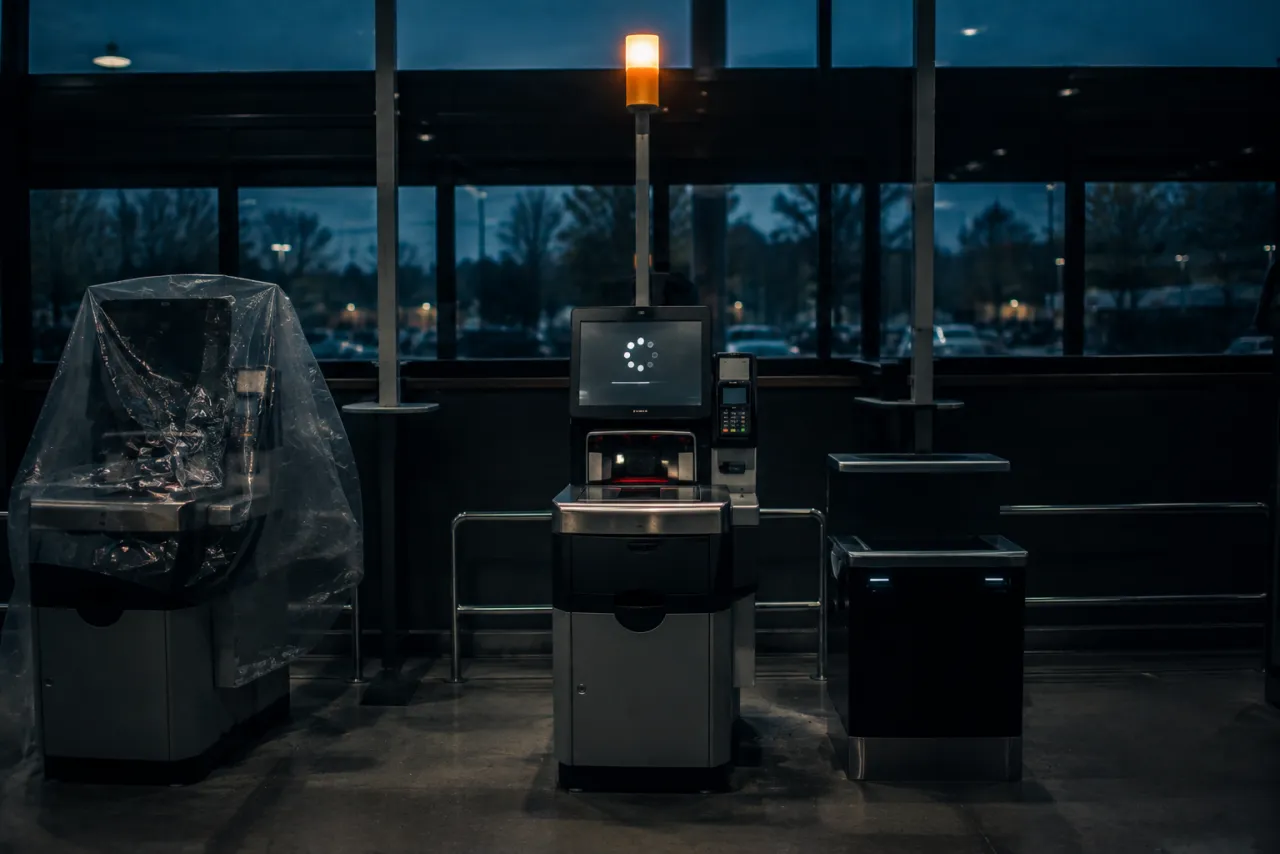
The light above kiosk four has been blinking for a minute and a half. The shopper stands there holding a bag of limes the scale refused to believe, scanning the front end for help that is not coming. Two machines to her left are dark, bagged off with plastic covers. This is the busiest checkout real estate in the store, and right now nobody official is watching it.
Self-checkout problems are a strange category of store failure because the equipment that creates them also writes the report card. The kiosks log uptime, transactions, and interventions, and the numbers roll up into a dashboard that usually looks fine. The customer’s version of the same transaction, three flags, two waits, one apology to the person behind her, appears nowhere.
That gap between machine truth and customer truth is why self-checkout deserves its own audit, run by a person standing in the lane with a stopwatch.
Why Self-Checkout Problems Hide From Dashboards
The system reports machine states, not customer experiences. A kiosk that is powered on but bagged off because the cash module jams counts as available. An intervention gets logged when the attendant badges in, not when the light started blinking, so the wait that defined the customer’s trip is invisible. A card reader that takes three tries still ends in an approved transaction, which is the only part the dashboard keeps.
Downtime reporting has the same blind spot. A lane is officially down when someone opens a ticket. Plenty of lanes limp along for weeks, half-broken and unticketed, because closing one is easier than escalating it.
Downtime You Will Never See a Ticket For
The first thing an observer counts is simple: kiosks installed versus kiosks actually usable. Not powered on, usable. A machine with a handwritten card-only sign is a partial outage. A machine with no sign that rejects cash at the payment step is worse, because the customer discovers the outage at the end of the transaction, at the worst possible moment.
Run the count at peak and off-peak. A store that runs six kiosks at ten in the morning and four at six in the evening has a downtime pattern no ticket queue will ever show you, and it is happening precisely when the front end needs capacity most.
The Intervention Wait: The Light Is On, Nobody Comes
If you measure only one thing at self-checkout, measure this. Age check, weight mismatch, produce lookup, coupon: the machine flags, the light comes on, and the transaction freezes until a human arrives. The number that matters is the time from light-on to attendant arrival, and no standard report surfaces it.
Watch what customers do during that wait. Some flag down any employee walking past. Some void the item in whatever way the machine allows. Some abandon the basket entirely and walk. The customer chose this lane for speed, and the intervention wait is the moment the store breaks that promise while appearing, on paper, to have completed a normal transaction.
Attendant Coverage Is a Staffing Decision You Can Watch
Every intervention wait traces back to coverage. The pod was designed for a dedicated attendant, but in practice that person gets pulled to a register, sent for bags, or borrowed by the service desk. An observer logs coverage in blocks: is the attendant present, positioned where the lights are visible, and facing the lanes, or present in name only?
Ratio matters too. One attendant covering four kiosks is a different job than one covering eight plus an express register. When operators are surprised by their own intervention waits, thin or absent coverage is routinely the reason, and it never looks like a problem on the schedule, where the shift reads as filled.
Error and Rejection Patterns Worth Logging
Beyond downtime and waits, the pattern of individual failures tells you whether the pod is maintained or merely tolerated. A field auditor running real transactions can document:
- Items that fail to scan on the first pass, especially produce lookups
- Weight-mismatch and unexpected-item flags on ordinary baskets
- Age-verification stops and how long each takes to clear
- Card reader retries, declined taps, and payment steps that need a restart
- Receipt printers that are out of paper in stores that check receipts at the exit
- Abandoned or voided transactions observed mid-visit
One flag is noise. The same flag recurring across visits is a calibration, training, or maintenance issue with a fix attached.
What Observation Measures That the System Cannot
A trained observer does not wait for problems, she orders them. A basket with loose produce, an age-restricted item, and a coupon forces the machine through its intervention states on demand, with a stopwatch running on every wait. Dark lanes and unmanned pods get photographed. Every event gets a timestamped note, and the visit produces a severity-coded record instead of an anecdote, assembled the way we describe in how our reporting works.
This is exactly what our Checkout Experience Audit does, at $225 to $325 per visit, across both staffed lanes and self-checkout. The output gives the intervention wait a number, and that number deserves a seat next to the execution KPIs you already track, because it moves basket abandonment and repeat visits in ways your uptime figure never will.
Put a Stopwatch on the Lane Nobody Watches
You could stand at your own pod for an hour and learn plenty. What you cannot do is stand at forty pods, on different days, at peak and off-peak, without being recognized, and that is the version of the truth worth acting on. Machines are consistent; the experience around them is not, and only observation at scale shows you the spread.
If self-checkout is a black box in your fleet, the 10-store pilot opens it: $7,500 all-in for ten anonymous visits with photo-backed, severity-scored reports and an executive debrief at the end, no long-term contract required. Get in touch and we will put the intervention wait on a stopwatch in every store you pick.